Independent survey for a Lombok build means four inspection gates — keel and framing, lamination or planking, systems installation, and sea trial — plus a pre-handover survey that produces a written defect list tied to the contract’s retention money. Every gate generates evidence-standard photographs, video and a written report, so an owner overseas sees exactly what a surveyor standing in the shed would see, before any milestone payment releases.
Why Inspection Is Built Into the Contract
The single biggest protection an owner has in any new build is simple: money only moves when inspected progress says it should. The desk’s supervision model, and the option to bring in fully independent third-party surveyors on top of it, exist to make that rule enforceable. Defects caught at the framing stage cost a day to fix; the same defects found at handover cost weeks and arguments. The contract mechanics that connect inspection to payment are set out on the contract, milestones and supervision page.
Stage Inspections During the Build
Keel and framing
Before any skin goes on, the inspection covers keel scarfs and fastenings, frame spacing and sizing against the specification, timber moisture and grade with SVLK papers sighted for hardwood structure, or the mould and core preparation on an FRP hull. This is the gate where the boat’s skeleton is either right or wrong, and it is the least expensive possible moment to correct it.
Lamination or planking
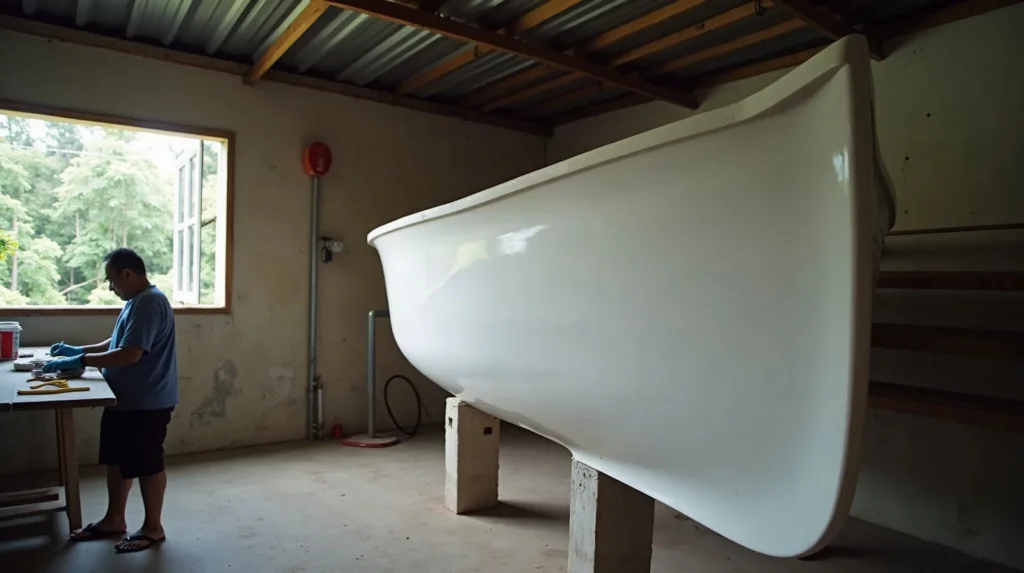
On FRP hulls the inspection verifies resin batch logs, laminate schedule against the drawings, sample coupons and cure conditions. On timber hulls it covers plank fit, fastening pattern and bedding, and caulking workmanship. Photographs are taken to an evidence standard — scaled, located, dated — not marketing shots.
Systems and sea trial
The systems gate checks engine alignment and mounts, fuel and electrical installation against the schedule, steering, bilge pumping and through-hull integrity. The sea-trial gate then proves the boat under load: loaded runs, manoeuvring, systems shakedown and instrumented readings, following the protocol described on the nine-stage build process page.
Pre-Handover Survey
The defect list protocol
Shortly before handover, the boat gets a full survey — structure, systems under load, safety equipment and the document file. Everything that does not meet the specification goes onto a written defect list with a severity class and an agreed rectification date. There is no “we’ll sort it after launch” category; either an item clears or it stays on the list.
The retention link
The final tranche of the contract price — the retention — releases only when the defect list clears. This is standard practice in serious shipbuilding and the desk applies it to every project, which changes the incentive structure for everyone in the shed during the final month.
Remote Owner Reporting
The evidence standard
Owners commissioning from overseas receive, at every gate: located and dated photo sets shot to a checklist, video walk-throughs of the actual hull, and a written report stating what was inspected, what passed, and what is open. Reports are in English; the underlying yard communication is handled by the bilingual desk.
Report cadence
Between gates, owners get a regular progress report on an agreed cadence, so a quiet fortnight in the shed is visible rather than discovered. The cadence is written into the supervision terms — it is a contract deliverable, not a courtesy.
Coordinating Third-Party Surveyors
For larger budgets the desk actively recommends an independent marine surveyor of the owner’s own choosing, and coordinates their visits at the stage gates where their eyes matter most. Independence is treated as a feature of the project, not a threat to it: the desk’s job is to make the yard’s work verifiable, and a third-party surveyor confirming that is the strongest evidence an owner can have. Where a project outgrows Lombok’s slipways and routes to specialist partner yards, the same gate-based inspection discipline travels with it.
What This Costs
Supervision and stage inspection are part of the desk’s engagement rather than hidden margins in the yard price; third-party surveyor fees are quoted transparently as a pass-through. Against the cost of one structural defect discovered after launch, inspection is the least expensive line in the whole budget — the price context sits with the bands on the boat building cost page.
Common Defects Each Gate Catches
Each inspection gate exists because it catches a specific family of problems. The framing gate finds undersized or badly scarfed structure, wet or ungraded timber, and frame spacing that drifted from the drawings. The lamination and planking gate finds dry glass, starved resin, missing laminate layers, poor plank fits and thin caulking — defects that vanish from sight the week after they are made. The systems gate finds misaligned shafts, unsupported fuel runs, undersized cables and through-hulls without proper backing. The sea trial finds vibration, overheating under sustained load and steering faults that never show at the dock. None of these are exotic; all of them are routine finds on unsupervised builds, which is precisely the argument for inspecting on schedule rather than on suspicion.
Frequently Asked Questions
Do I need an independent surveyor if the desk supervises?
For larger budgets, yes — and the desk actively recommends it. Supervision and independent survey do different jobs: the desk enforces the specification day to day, while a third-party surveyor of the owner’s own choosing verifies it with no stake in the schedule. The desk coordinates their visits at the stage gates; independence is treated as a feature of the project.
At which stages should a new build be inspected?
Four named gates: keel and framing, before the structure is skinned; lamination or planking, while workmanship is still visible; systems installation, before linings close; and sea trial under load. Each gate catches its own class of defect at the moment it is least expensive to fix — the sequencing follows the nine-stage build process.
What does a pre-handover survey cover?
Structure, systems exercised under real load, safety equipment, and the completeness of the document file — measurement, registration and certification. The output is a written defect list with severity classes and rectification dates, tied directly to the contract retention so clearing it is nobody’s optional extra.
Can inspections be followed from overseas?
Yes — that is what the reporting standard exists for: located, dated photo sets shot to a checklist, video walk-throughs of the actual hull, and a written English report at every gate stating what passed and what is open. Remote owners see the same evidence a surveyor in the shed sees, on a contractual cadence.
Slipways around Awang and Labuhan Lombok comfortably handle hulls up to the mid-twenty-metre range; beyond that, haul-out capacity and class attendance become the constraint rather than craftsmanship. When a commission outgrows those limits, supervision continues under the group’s new-build supervision practice, with the same milestone-and-survey discipline applied at larger yards.
Related reading: what a lay-up inspection actually looks for — voids, resin ratio and the tell-tale print-through.