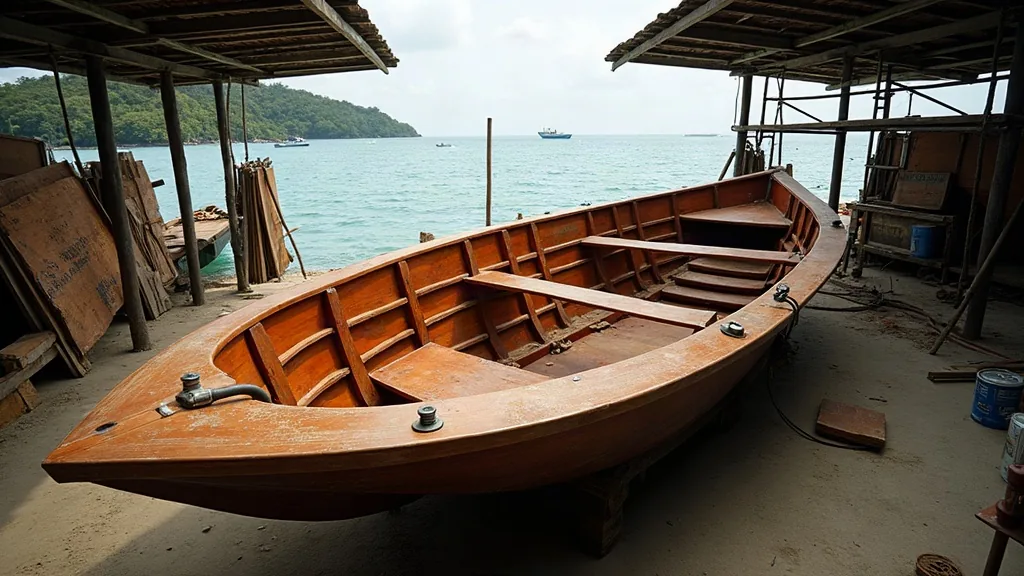
As a dive boat builder in Lombok we design and construct day boats for Gili and Lombok operations around tank flow, diver safety and fast turnarounds: stable hulls, efficient tank racks, practical compressor layout, safe ladders and entries, shaded deck, dry storage and an interior plan that balances legal capacity with real comfort in local sea and monsoon conditions.
What matters in a Gili and Lombok dive boat layout
Dive and tourist day boats for the Gili Islands and Lombok run short, intensive schedules. The hull and deck plan must support rapid turnarounds, repeated boarding at beach jetties and reliable performance in afternoon chop across Teluk Nara–Gili and Senggigi–Gili routes.
For a kapal diving Lombok or mixed-use day boat, the critical layout decisions are:
- Passenger capacity versus deck space for divers gearing up
- Tank rack placement and bottle flow from filling to loading to water entry
- Compressor location, air intake and noise control
- Ladder, entry and exit system in 0.8–1.5 m swell
- Shaded versus open deck area
- Dry storage, electronics and camera-safe spaces
- Fuel, freshwater and wash-down routing for 2–4 trips per day
Capacity versus comfort on Gili shuttle and dive operations
On Gili routes, passenger licences often push you to load more seats. Operationally, overcrowding reduces diver satisfaction, slows gearing up and increases slip and trip risks on wet decks.
We usually plan day boat builder Lombok projects by separating regulatory capacity from practical dive load. Kemenhub and Syahbandar will calculate a legal passenger count from hull dimensions and freeboard. For daily use, we recommend a lower working number for dive configurations than for pure sightseeing runs.
| Use case | Indicative LOA (m) | Typical engine setup | Regulatory passenger band* | Practical dive load band* |
|---|---|---|---|---|
| Dedicated Gili dive boat build | 11–15 m | 2 x 200–300 HP outboard or inboard diesel | 20–45 pax | 12–24 divers + 2–4 crew |
| Mixed dive + sightseeing day boat | 13–18 m | 2–3 x 200–350 HP or 1–2 inboard diesels | 30–60 pax | 16–28 divers or 30–50 sightseers |
| Tourist transfer & snorkel day boat | 10–13 m | 2 x 150–250 HP outboard | 20–40 pax | 20–32 snorkellers + 2–3 crew |
*All bands indicative and subject to final design, survey and Kemenhub approval for your operating area.
For operators already running high-speed transfers, combining a dive-friendly deck plan with a hull similar to a fast boat build specification can shorten Gili run times while still allowing safe, controlled entries at the dive site.
Hull choice and sea conditions around Lombok
The sea conditions off Lombok vary from flat early-morning transits between Teluk Nara and Gili Trawangan to steeper seas near the Pemenang headland or on longer runs towards Sekotong and the south.
We typically discuss hulls in three bands:
- Mono-hull planing boats – common for Gili and Senggigi routes; easier to beach, simpler to build and maintain; efficient at medium to higher speeds.
- Wide-beam mono-hulls – more initial stability at rest for gearing up, slightly higher build cost, useful for camera-intensive dive operations.
- Catamarans – increased deck area and stability at rest; useful for mixed snorkel and dive boats operating in choppy afternoon conditions; more complex structure and weight distribution planning.
Material choice affects weight, maintenance and schedule. Some operators favour timber for ease of local repair, others move to fibreglass for smoother underwater shapes and lower routine hull maintenance. Early in the discussion we recommend reviewing the options in the hull materials overview so that your dive-deck requirements are aligned with the chosen scantlings and laminate schedule.
Tank racks, compressor position and air flow
On a busy gili dive boat build, tank handling is where time is lost or gained. Racks must be positioned to protect valves, give clear walkways and allow fast loading from the pier or support boat.
Tank rack planning
- Decide working dive capacity first (e.g. 16, 20 or 24 bottles on board).
- Provide at least one clear fore–aft path so crew are not forced to step over fins and hoses.
- Align racks with the vessel’s centreline where possible to minimise rolling discomfort when divers lean out to gear up.
- Include handholds and grab rails close to all bench positions.
Compressor and filling layout
Onboard compressors save quay time between trips but require careful structural and ventilation planning.
- Keep the compressor low and central for weight, typically near the engine box or machinery space.
- Separate compressor intake from exhaust and engine fumes; avoid drawing air from an enclosed lazarette.
- Design pipe or whip routing so tanks can be filled in racks without blocking walkways.
- Consider noise shielding so briefings and marine-life explanations remain audible under way or at anchor.
For shore-based filling operations, we adjust the design to optimise bottle loading from trolleys: clear gunwale doors, strong points for lifting slings and direct paths from pier to rack.
Ladders, entries and diver circulation
Entry and exit design strongly affects safety on exposed sites around Gili Meno walls, Gili Air slopes or Sekotong islands. A dedicated dive ladder zone keeps divers clear of propellers, exhausts and hull shapes that can push them under the boat in swell.
- Dive ladders – rigid ladders with deep steps and handrails on both sides, mounted inboard of the transom corners; steps must extend well below the surface to help divers with negative buoyancy or leg cramps.
- Giant-stride platform – a transom or side platform with clear, unobstructed area, allowing one diver at a time to enter; railings should guide, not obstruct, fin movements.
- Snorkeller access – if the boat doubles as a snorkel vessel, a separate ladder or side entry avoids mixing heavily equipped divers with casual snorkellers.
- Propeller protection – for outboards, consider guards and strict engine-off zones during recovery; for inboards, keep divers well clear of the stern line and rudder.
Circulation planning must cover the full cycle: divers move from seating to entry point, then back to the ladder, to the rinse and de-kitting area, and finally to a dry, shaded seat. Each segment should avoid cross-traffic with crew carrying spare tanks or moving mooring lines.
Shade, dry storage and topside comfort
On tourist routes Lombok–Gili and day trips around the Gilis, shade coverage has direct impact on client comfort and sunburn risk, especially for repeat trips.
- Rigid canopy – strong fixed roof over primary seating and gear-up area; sized for local wind loads and to handle occasional green water.
- Removable side screens – for wind and spray protection on afternoon return journeys from Gili Trawangan to Bangsal or Teluk Nara.
- Dry storage – dedicated lockers for phones, towels and camera gear, separated from wet equipment zones and away from deck drains.
- Toilet placement – compact, easy-to-clean heads located with direct access from deck, without routing wet divers through wheelhouse or galley spaces.
Tourist-oriented layouts for sunset cruises or island-hopping may trade some tank rack capacity for bench seating and tables. As a tourist boat builder Lombok operator briefing, we will normally ask you to define your split between pure diving, snorkel trips and non-diving sightseeing before locking in canopy footprint and furniture.
Turnaround speed and systems for multiple daily trips
Most Gili and Lombok day boats run multiple rotations: early-morning dive, mid-morning snorkel or transfer, afternoon dive or sunset run. The build must support rapid reset without crew fatigue.
- Deck drainage – fast, directed overboard scuppers keep decks dry between groups; reduces time spent with squeegees.
- Freshwater and rinse – simple hose or deck shower systems, with tanks sized for the number of daily users; separate camera rinse containers recommended.
- Fuel capacity – plan bunkering frequency against typical Gili–Lombok legs and engine choice, avoiding mid-day refuelling where possible.
- Equipment stowage – racks and shelves for spare masks, fins and SMBs, located near crew positions, not buried forward.
- Helm layout – clear sight lines to ladders and stern area from the helm station for safer diver recovery and approach to moorings.
Regulatory framework for passenger and dive day boats
Dive and tourist day boats in Lombok waters operate under Indonesian regulations via Kemenhub and local Syahbandar offices, with BKI rules often informing structure and stability. For each new build we will work towards compliance for:
- Passenger capacity and load line according to hull form and freeboard
- Safety equipment: lifejackets, lifebuoys, firefighting gear and emergency lighting
- Navigation lights and basic electronic requirements for your operating area
- Documentation such as Surat Ukur, Gross Akte and Pas Besar as required
For vessels likely to operate mixed roles (transfer, diving, snorkelling and sightseeing), we encourage owners to define clearly which mode is primary, as this can influence how the inspector views passenger arrangements, seating and open deck usage.
What to send the Build Desk for a scoped dive/day boat proposal
To receive a scoped response from Lombok Boat Builder Build Desk, send by WhatsApp +6281139414563 or email bd@juaraholding.com:
- Intended operating area (e.g. Teluk Nara–Gili, Senggigi, Sekotong, Labuan Bajo) and typical sea conditions you expect to run in.
- Primary role (dedicated diving, mixed dive/snorkel, or tourist day and sunset cruising) and your target working passenger/dive capacity.
- Preference for hull material and approximate length overall if known, or comparable boats you operate now.
- Desired engine type (outboard or inboard), approximate cruising speed and number of trips per day.
- Compressor requirements (onboard or shore-based), tank sizes and number of tanks to be carried.
- Any special features: camera tables, rinse tanks, disabled access, private toilet, upper deck seating or beach loading requirements.
If you have a budget band in USD and a target delivery window, include these so we can respond with indicative build paths and next steps. You can also review commercial points and next actions on the price and quote guidance page before contacting the build desk.
Frequently Asked Questions
What does a 12-diver boat cost to build in Lombok?
Plan against the day-boat band — dive day-boats of 15–20 m commonly land around USD 320,000–650,000 depending on layout, speed and yard-supplied equipment, with the engine package the biggest swing factor. Smaller open dive boats for short Gili runs come in below that. Per-metre framing and the full table are on the cost guide.
Open deck or cabin for Gili diving?
For short runs out of the Gilis, an open deck with hard shade wins: faster loading, easier briefings, better airflow, simpler maintenance. Cabin variants earn their cost on south-coast and longer-range sites where passengers need weather protection between distant moorings.
Can one hull serve diving and snorkel day trips?
Yes — convertible layouts are a standard desk specification: removable or folding tank racks, bench seating that reconfigures, and stowage planned for both gear sets. The conversion is designed in at the drawing stage so the crew can switch modes in minutes, not with tools.
What safety kit is mandatory for a commercial dive boat?
The registration-linked safety certificate covers lifejackets, rafts, fire and signalling equipment, and dive operations add oxygen provision and a diver-recall capability. The desk sequences certification so everything is aboard and documented before the first paying guest — not retrofitted after an inspection fails.
Related reading: dive boat layouts used by Gili Air operators — tank racks, ladders and deck flow that work in practice. glass-bottom and snorkel boat builds for Gili day trips — specs and cost bands for the viewing-hull variant.