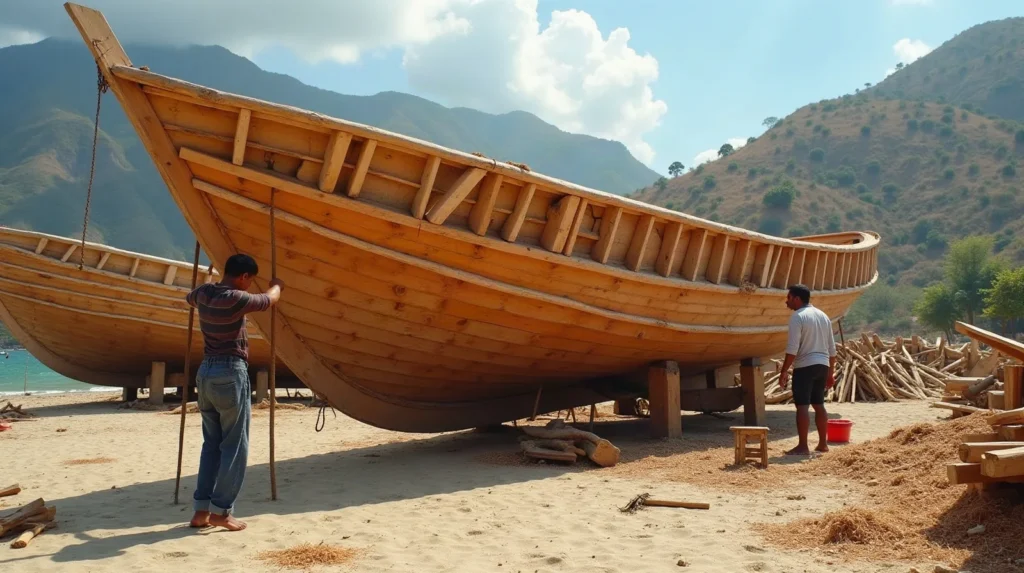
A working fishing boat commissioned through the Lombok build desk is typically a 10–16 m timber or FRP hull in the Awang and Tanjung Luar working lineage, fitted with an insulated ice hold, a mid-range diesel inboard and deck gear matched to the fishery. Built to a written contract with staged payments, simple open working hulls sit in the USD 12,000–18,000 per-metre band, with engines and hold specification moving the final number most.
What “Working Hull” Means Here
Lombok’s south and east coasts have built fishing boats for generations. The hulls that leave Awang and Tanjung Luar are not showpieces — they are tools that go to sea most days of the year, carry ice and catch, take a beach landing without drama, and get repaired with local skills and local materials. That lineage is exactly what the desk specifies when an owner orders a boat that has to earn.
The difference between a desk-commissioned working boat and an informally built local hull is not the shape of the bow. It is the paperwork and the discipline around it: a written specification, legally documented timber, staged payments released against inspected progress, and the registration file started before launch. Owners who need bank finance, insurance or a commercial fishing licence need that file to exist. The full commissioning sequence is described in the owner’s guide to building a boat in Lombok.
Hull Styles From Working Harbours
The Awang and Tanjung Luar lineage
South-coast builders around Awang and the east-coast fleet at Tanjung Luar — Lombok’s largest fish-landing harbour — favour long, moderately narrow timber hulls with generous sheer, a raked stem for beach and surf work, and framing sized by inherited rules that have survived decades of daily use. These boats ride dry, carry well and forgive overloading better than most modern designs. The desk documents that inherited scantling practice into a written specification so the owner knows exactly what is being built, plank by plank. Where each style of hull is actually built, and which slipway suits which size, is mapped on the Lombok working-yards page.
Timber or FRP for fishing work
Both materials earn their keep, and the honest answer depends on the fishery:
- Timber — lower first cost at working sizes, repairable in any harbour on the island, and comfortable in a seaway. It demands an annual haul-out, recaulking discipline and preservative treatment, and hold insulation takes more care to do well.
- FRP (fibreglass) — higher first cost, but a moulded or one-off FRP hull takes ice-hold insulation cleanly, sheds borer and rot risk entirely, and cuts the annual maintenance bill. For boats that will fish hard for fifteen years, lifetime cost often favours FRP.
The full decision table, including aluminium for specialist cases, is on the hull materials comparison.
Working Fit-Out
Ice holds and insulation
The hold is the boat’s bank account. The desk specifies hold volume from the target fishery and trip length, then insulation thickness and lining to keep ice for the intended days at sea. In timber hulls that means a lined, drained box with closed-cell insulation; in FRP it can be moulded in. A poorly insulated hold quietly costs an owner a percentage of every catch — this is where budget builds lose money for years.
Outriggers, davits and deck machinery
Outrigger geometry, net or line haulers, davits and fish-handling layout are specified per fishery. The rule the desk applies: every load path from gear to hull structure is drawn and sized before the keel goes down, because bolting a hauler to an unreinforced deck is how working boats break.
Engines and Running Cost
Diesel inboard choices
Working hulls in this size band run marine diesel inboards in roughly the 30–150 hp range depending on length, displacement and the speed the fishery actually needs. The desk specifies engines with parts and mechanic coverage reachable from Lombok, because an exotic engine with no local support is a liability the day it stops.
Fuel and maintenance reality
A displacement working hull is economical to run at hull speed and expensive to run above it. The specification therefore fixes a realistic service speed first, then sizes the engine to it, rather than paying for horsepower the boat cannot use. Budget planning for fuel, filters, zincs and the annual haul-out is set out in the handover pack, and the overall cost picture — including how engines move the total — lives on the USD price-band page.
Paperwork for a Working Boat
A commercial fishing boat needs its measurement (Surat Ukur), registration — the Pas Kecil route for hulls under 7 GT, Pas Besar above — and the fishing licence sequence with the owner’s local permits before it can legally work. The desk starts this file during the build so the boat is not finished and then stranded ashore waiting for documents. Statutory government fees are modest and are stated factually in IDR in the quotation; contract pricing itself is in USD. The document sequence is explained in full on the certification and registration page.
How to Start
Send the desk the fishery, the trip length, the crew count and the budget band by WhatsApp or email. A scoping call follows, then a written line-item quotation tied to a construction contract issued by PT Komodo Galangan Nusantara, with milestone payments released only against inspected progress. No stock hulls, no verbal quotes — a working boat specified for the work it will actually do.
Frequently Asked Questions
How much is a new fishing boat in Lombok?
Desk-commissioned working hulls sit in the simple-workboat band — roughly USD 12,000–18,000 per metre for open timber or FRP working boats built to contract, survey and documentation standard, with the engine and ice-hold specification moving the total most. Informally built local hulls cost less but come without contracts, inspection or a registration file. Government fees are stated factually in IDR.
Which lasts longer for fishing work, timber or fibreglass?
Both last with the right care, and the trade-off is plain: timber is repairable in any harbour and less expensive at first, but demands annual haul-out and recaulking discipline; FRP costs more upfront, sheds rot and borer risk entirely, and takes ice-hold insulation more cleanly — which is why hard-fished boats often favour FRP on lifetime cost.
Can the desk handle the fishing licence paperwork?
The desk coordinates the sequence — measurement, registration via the Pas Kecil or Pas Besar route, safety certification and the fishing licence steps with the owner’s local permits — and starts the file during the build so the boat can legally work as soon as it is wet. The owner remains the licence holder throughout.
Do Lombok yards build to order or sell stock hulls?
To order. Hull length, hold volume, deck layout and engine are specified per owner and per fishery before the keel goes down, and lead times are quoted honestly against the yard’s real current workload — typically several months for a working hull, longer in peak season.