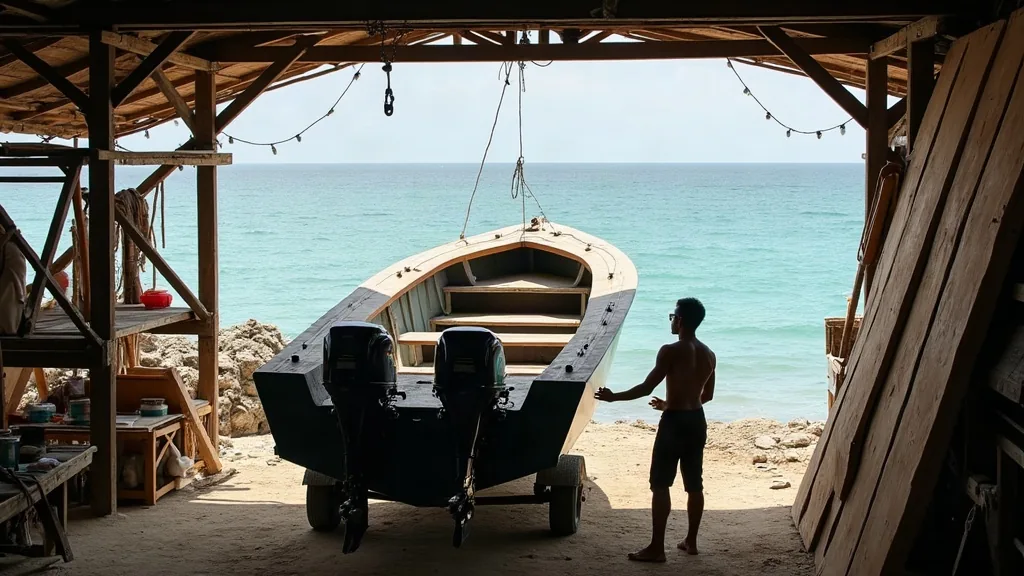
A compliant, economic Gili fast boat typically uses a medium-deadrise planing hull in GRP or aluminium, seats 40–100 passengers under Kemenhub approval, runs twin or triple outboards in the 300–450 hp range, cruises around 18–26 knots on the Lombok Strait, and carries full SOLAS-lite safety gear with watertight bulkheads, bilge pumping, and clear escape routes sized to the route’s wave climate.
What a Gili Fast Boat Must Do Well
For the Gili crossing and Lombok–Bali fast boat routes, the design problem is straightforward: move passengers quickly, safely and economically across short, often choppy legs. A capable gili fast boat builder must balance initial capital cost, long-term fuel burn, engine maintenance, and Kemenhub passenger compliance.
The result is usually a long, narrow, relatively light hull with enough deadrise and structure to keep slamming under control, while still planing at practical speeds with realistic loading and fuel.
Hull Form and Sea State on the Lombok Strait
The Lombok Strait and the channels around Bangsal, Teluk Nara and Senggigi present steep, short-period chop, strong currents and confused seas when wind and swell oppose each other. Hull form decisions for a passenger fast boat Lombok service need to recognise this.
Typical Fast Boat Hull Choices
- Monohull planing hull – Common for 40–100 pax. Medium V (around 18–22° at the transom), fine entry forward, lifting strakes and spray rails. Good compromise between speed, fuel and seakeeping.
- Catamaran planing hull – Twin slender hulls. Can offer better ride comfort and stability, but requires careful structural design at the tunnel and may need more tooling cost up front.
Key Hull Design Considerations
- Deadrise and entry – Enough V to land softly in head seas, not so much that the boat struggles to plane with full passengers and fuel.
- Beam and stability – Beam must support seating layout and gangways while keeping transverse stability within Kemenhub criteria during evacuation and damaged conditions.
- Freeboard – Higher sides and adequate bow height are important on exposed Senggigi–Gili and Lombok–Bali runs, limiting green water on deck.
- Structure – Frames, longitudinal stringers and bulkheads must suit the laminate or scantling schedule and the expected slam loads in local sea states.
The choice of GRP or aluminium is addressed in more detail on the hull materials and construction options page, but both can be engineered to the required strength and weight for the Gili crossing profile.
Passenger Capacity, Layout and Kemenhub Approval
Kemenhub passenger approval is not only about how many seats fit in the cabin. It is driven by evacuation time, door and aisle widths, life-saving appliances, stability, and fire protection. A speedboat builder Lombok operator uses must integrate these from the first sketch, not as late additions.
Seat Count and Layout
- Typical capacities – Indicatively 40–60 pax for smaller Gili fast boats; 80–120 pax for larger inter-island or Lombok–Bali services, subject to design and survey.
- Aisles – Clear central and side aisles, avoiding dead ends and narrow choke points near doors.
- Doors and exits – Enough width and number of exits to match the approved passenger count and route category.
- Luggage – Dedicated luggage racks or aft stowage to keep bags off decks and escape routes.
Regulatory Documents and Survey
A compliant pembuat kapal cepat Lombok project will be designed with the required documentation in mind: General Arrangement drawings, stability calculations, structural plans and machinery layouts sufficient for class or local surveyor review. These then support issuing Surat Ukur, Gross Akte and Pas Besar through the local Syahbandar once construction and trials are complete.
For operators seeking classification or specific notations, the design must also be aligned early with the applicable rules, as outlined on our class certification and regulatory pathway page.
Engine Packages, Speed and Fuel Planning
Fast boat builder Lombok projects for the Gili crossing mostly use high-power outboards for ease of service, redundancy and weight savings. Inboard diesels with waterjets are more common where heavy luggage, vehicle ramps or shallow draft constraints apply.
| Parameter | Typical Gili Shuttle | Typical Lombok–Bali | Notes |
|---|---|---|---|
| Length overall | 12–18 m | 15–24 m | Subject to passenger count and route |
| Passenger capacity | 40–80 pax | 60–120 pax | Final approval by Kemenhub survey |
| Main engines | Twin or triple outboards, 300–450 hp each | Triple or quad outboards, 300–450 hp each, or twin diesels | Choice driven by speed, redundancy and service network |
| Service speed | 18–24 knots | 20–26 knots | Planned for loaded condition and typical sea state |
| Fuel capacity | 800–1,500 litres | 1,500–3,000 litres | Planned for daily cycles plus reserve |
Indicative fuel burn is calculated during the design phase using conservative specific fuel consumption and propeller efficiency assumptions. The operator can then model daily legs Bangsal/Teluk Nara/Senggigi–Gili and Lombok–Bali turnarounds, with allowance for adverse weather detours and reserve fuel margins.
Safety, Stability and Passenger Protection
A gili fast boat builder must treat safety as a design driver, not a checklist at outfitting. For short, frequent legs, risk comes from repeated exposure to docking, high-density passenger movements, and sudden weather changes rather than only from long ocean passages.
Key Safety Fit-Out Elements
- Watertight subdivision – Collision bulkhead, engine-room bulkheads and, where appropriate, additional transverse bulkheads with watertight doors.
- Bilge systems – Distributed bilge suctions, automatic and manual pumps sized for compartment volumes.
- Life-saving appliances – Lifejackets for all persons on board, additional child-size units, life rafts and throw rings to the approved headcount.
- Fire protection – Fixed fire suppression in machinery spaces, portable extinguishers to regulation, fire detection in enclosed spaces.
- Handrails and non-slip – Robust grab rails, non-slip decks at boarding points, and clearly marked step edges.
- Visibility and communication – All-round bridge visibility, navigation lights, AIS where required, VHF and backup communication equipment.
Weather, Monsoon and Operational Limits
The design operating envelope should be matched to the local monsoon pattern. For example, operators may set a maximum wave height or wind limit above which crossings are suspended. The hull, windows, deck drainage and anchor/mooring gear are then specified to safely handle operations at the upper edge of normal service conditions and controlled returns when conditions deteriorate.
Decks, Boarding and Cargo Handling
Fast boats serving Gili Trawangan, Gili Meno and Gili Air must load and unload passengers efficiently at Bangsal or Teluk Nara, and at island jetties or beach landings where applicable. A practical passenger fast boat Lombok layout reflects this in both structure and outfitting.
- Boarding doors and steps – Side doors at midships or aft with strong, easily deployed gangways sized for the expected jetty heights.
- Roof deck use – If a rooftop viewing deck is desired, design must address additional structural loading, rail heights and access ladders or stairs.
- Cargo and luggage – Separated areas for gas bottles, supplies and guest luggage, with adequate lash-down points and drainage.
- Protected wheelhouse – Good weather protection for the helm, wipers, demisters and shading to reduce fatigue on many short legs per day.
Operators running mixed passenger and activity trips, such as snorkelling or diving, may require transom swim platforms, boarding ladders and gear stations more typical of a dedicated dive boat build. These can be integrated into the same hull platform if considered early.
Budget, Build Timeline and Specification Control
Total project cost for a new fast boat builder Lombok contract varies widely with length, engines, interior finish and regulatory pathway. The practical approach is to set a target passenger count, route, and desired service speed, then work back through hull size, structure, propulsion and equipment.
Build time is strongly influenced by material choice, mould availability, class or flag requirements, and the level of custom interior work. Clear, early decisions on layout, machinery brand preferences and route documentation typically shorten both design and construction duration.
To assemble an indicative investment band, operators are encouraged to provide route plans, passenger targets and any known regulatory constraints so that we can prepare a structured response, as outlined on our price and quotation planning page.
What to Send the Build Desk for a Scoped Fast Boat Proposal
To receive a scoped reply from the Lombok Boat Builder Build Desk, send on WhatsApp +6281139414563 or email bd@juaraholding.com the following information:
- Intended routes (e.g. Bangsal–Gili Trawangan, Teluk Nara–Gili Air, Senggigi–Gili Meno, Lombok–Bali) and planned trips per day.
- Target passenger capacity (seated), any standing or rooftop deck use, and luggage expectations.
- Preferred service speed range and any fuel economy priorities.
- Preference for outboard petrol or inboard diesel engines, and any brand or service-network constraints.
- Route authority requirements you must satisfy (Kemenhub, class, local Syahbandar specifics).
- Berthing and boarding conditions at each port or beach, including jetty heights and seasonal swell.
- Any special features: VIP cabin, rooftop deck, snorkelling or dive facilities, cargo capacity.
- Desired build start window and whether you have an existing hull, or require a complete new build.
With this, the build desk can outline hull options, approximate engine sizing, indicative fuel planning and a staged pathway from design and approvals through to launch on your chosen route.
Frequently Asked Questions
How much does a Gili fast boat cost to build?
Budget by band, not a single number: passenger fast-boat projects commonly sit in the USD 16,000–30,000 per-metre range depending on length, layout and finish — and the honest note is that engines are often close to half the budget on outboard-powered hulls. The current bands and what moves them are on the USD price-band page.
How many passengers can a Lombok-built fast boat carry?
Certified capacity follows the measured hull, stability, exits and safety equipment — not the seat count a builder claims. Typical desk builds for Bangsal–Gili work run in the 20–40 seat class, with larger inter-island layouts possible where the hull and certification scope support them.
Which engines do Gili operators choose?
Outboard packages dominate the crossing: they suit shallow beach and jetty loading, are fast to swap out when a unit needs service, and keep the engine room out of the passenger space. Inboard diesels appear on longer-range and higher-capacity hulls where fuel burn per mile matters more than swap-out speed.
Can the boat run Bali–Gili, not just Bangsal–Gili?
Yes, with a bigger specification: the open Lombok Strait legs demand more fuel, more freeboard, heavier structure for the sea state, and a certification path matched to the route category. It is less expensive to specify the open-water version on day one than to upgrade a short-hop boat later.
What certification does a passenger fast boat need in NTB?
Measurement, registration, safety certification and crew licensing must all be in place before commercial passengers board, and the requirements are checked at NTB ports. The desk sequences this file during the build — the full document path is on the certification page.
Related reading: fuel and range planning for the Lombok-Gili-Komodo corridor — tankage decisions made before the deck goes on. design choices that cut noise and vibration — why the quiet boat wins repeat charters.