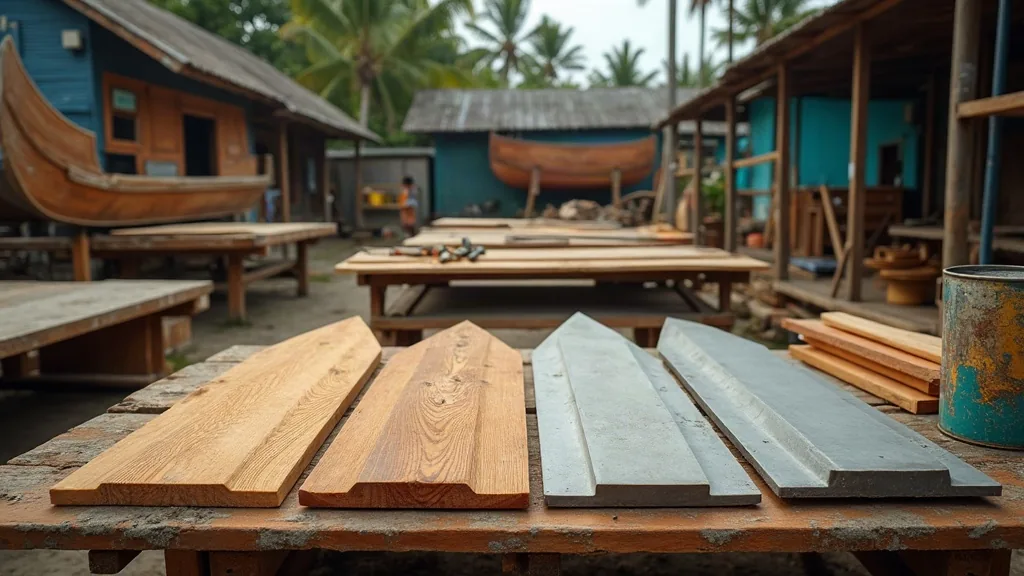
The right Lombok boat hull material depends on how you will use the vessel, your maintenance appetite and where the boat will be based. For island-hopping and tourism in NTB, timber or fibreglass are usually the most practical. Aluminium suits high-speed workboats and tenders. Steel is a niche choice for heavier expedition or cargo hulls with robust engineering support.
Overview of Lombok boat hull material choices
On Lombok and across Nusa Tenggara, all four major hull materials can be built, maintained and surveyed: traditional hardwood timber, fibreglass (FRP), aluminium and steel. Each behaves differently in local heat, humidity and marine growth, and each has a distinct cost profile for construction, docking and repair.
When specifying a new build with Lombok Boat Builder, we look at:
- Operating area: Gili islands, Lombok–Bali strait, Sumbawa, Labuan Bajo or longer-range voyages.
- Duty cycle: day boat, liveaboard, cargo, dive boat, fast passenger, or private yacht.
- Shore support: which yards, welders, carpenters and mould shops are realistic for your routes.
- Regulatory plan: BKI class or non-class, Kemenhub passenger approval, Syahbandar expectations.
The combination of these factors usually pushes the decision quite clearly toward timber, fibreglass, aluminium or steel.
Comparison table: timber vs fibreglass vs aluminium vs steel
The table below gives indicative comparisons for a 18–30 m vessel working around Lombok. Values are for planning only and will move with final scantlings, outfit and loading.
| Hull material | Indicative build cost index* (relative) | Structural weight (approx. vs timber) | Maintenance load (Lombok conditions) | Repairability in Indonesia | Indicative service life (years, with proper care) | Best-fit use cases |
|---|---|---|---|---|---|---|
| Timber (traditional hardwood) | 1.0 | Baseline | High: regular anti-fouling, fastener checks, rot/borer vigilance | Excellent: skills and timber widely available | 20–35+ | Liveaboard phinisi, charter yachts, slow passenger/cargo, character vessels |
| Fibreglass (FRP) | 1.1–1.4 | Lower than timber for same strength | Low–medium: gelcoat and osmosis watch, standard anti-fouling | Good in main hubs; fair in smaller islands | 25–40+ | Dayboats, dive boats, fast passenger, small ferries, private cruisers |
| Aluminium | 1.4–1.8 | Significantly lighter than timber/steel | Medium: corrosion management, anodes, paint system discipline | Moderate: specialist welders/cladding shops needed | 25–35+ | Fast boats, patrol/workboats, tenders, fuel-efficient island hoppers |
| Steel | 1.3–1.7 | Heavier than timber/aluminium | Medium–high: rust control, coatings, bilge cleanliness | Good in industrial ports; moderate in smaller harbours | 25–40+ | Expedition vessels, cargo, utility barges, heavier displacement yachts |
*Cost index is a planning ratio, not a quotation. For a precise estimate, we work from a defined GA, structural concept and specification.
Timber hulls: character, capacity and local support
Timber is still the most familiar bahan lambung kapal Lombok for large traditional hulls, especially charter phinisi and liveaboard yachts. Local carpentry, wood supply and docking are well adapted to ulin, bengkirai and other Indonesian hardwoods.
A timber hull suits you when:
- You want traditional aesthetics and generous internal volume for cabins and saloons.
- Your routes include Bangsal, Teluk Nara, Labuan Bajo and smaller anchorages where timber repair skills are common.
- You accept a higher maintenance rhythm: caulking, fastener checks, plank monitoring and regular anti-fouling.
Weaknesses include weight, hull movement, and the need for careful ventilation and bilge management to control rot and borers. Proper design of scantlings, limbering and structural connections is vital. For owners prioritising traditional builds, the wooden boat build options in Lombok page details our approach to framing, planking and composite superstructures over timber hulls.
Fibreglass (FRP) hulls: stable, predictable and versatile
Fibreglass is now the most common modern bahan lambung kapal Lombok for small to medium commercial vessels and private boats. A competent fiberglass boat builder Lombok can lay up single-skin or sandwich laminates, with stiffeners and bulkheads tuned to Kemenhub requirements.
Advantages of a kapal fiberglass Lombok build:
- Stable structure with minimal movement, making doors, windows and interior fit-out easier.
- Lower routine maintenance on the hull shell compared with timber or steel, if the laminate is specified and built correctly.
- Good impact absorption for dayboats and dive boats operating close to reefs and piers.
- No corrosion in the laminate itself, and no marine borers.
Points to watch:
- Laying up in tropical heat needs controlled resin systems and cure management to avoid print-through and weak bonds.
- We specify laminate schedules with attention to local slamming loads in Lombok–Bali crossings and frequent beaching in shallow anchorages.
- For high-speed hulls, weight control and proper core bonding are critical for performance and fuel burn.
For most tourism dayboats, smaller fast passenger vessels, and private cruisers up to around 25–30 m, fibreglass offers a balanced compromise between build cost, weight, and maintenance. Many of our fast boat hull forms for Lombok–Bali routes are best executed in FRP or aluminium, depending on speed and payload.
Aluminium hulls: speed, efficiency and impact resilience
Aluminium suits owners prioritising speed, payload and efficient fuel use, especially when running frequent crossings between Lombok, Bali and the Gilis. As an aluminium boat builder Lombok, we pay attention to weld procedures, heat-affected zones and proper isolation of dissimilar metals.
Why choose aluminium:
- High strength-to-weight ratio allows finer entries, higher planing speeds and reduced installed horsepower for a given service speed.
- Good damage tolerance: dents rather than cracks in many impact events, and robust structural repair by welding.
- Recyclable material, with plate and extrusions widely available in Indonesia.
Operational considerations:
- Corrosion control requires disciplined anode management, paint systems, and electrical isolation of stainless fittings.
- Aluminium welding and fairing skills are less common in remote islands than timber work; planning home ports and service yards is important.
- Thermal insulation and condensation control need careful design in cabins and accommodation spaces.
Aluminium is particularly well-suited to fast passenger boats, patrol or resort boats, and owner-operated vessels where performance and fuel burn are primary drivers and maintenance is centralised in ports with competent welders and coating applicators.
Steel hulls: robust platforms for heavier missions
Steel hulls are most relevant where displacement, cargo capability and ruggedness are more important than light weight and top speed. Around Lombok and Sumbawa, steel is common in cargo and work vessels operating from larger ports.
Benefits of a steel hull:
- High toughness and impact resistance, well-understood behaviour under global and local loads.
- Ease of structural modification: the hull can be lengthened, fitted with new foundations, or altered more readily than FRP or timber.
- Well-supported by Indonesian welding, plate rolling and blasting/painting facilities in major shipyards.
Constraints:
- High structural weight, which can limit speed and require more engine power and fuel for a given service speed.
- Continuous attention to coatings, especially in bilges, chain lockers and ballast tanks, to control rust.
- Less attractive for small tourism dayboats where shallow draught and light displacement are wanted.
Steel becomes attractive for larger expedition yachts, long-range charter platforms, cargo, tugs and barges where robustness and adaptation over time justify the additional maintenance discipline.
Matching hull material to mission profile
To align material with your use-case, it helps to frame your mission profile in simple terms. Below is a concise guide for Lombok and Nusa Tenggara operations.
Tourism dayboats and dive boats (8–24 m)
- Best fit: Fibreglass or aluminium.
- FRP offers smooth finishes, easy cleaning, and predictable performance.
- Aluminium is justified where higher speeds, tighter schedules and heavy daily cycles demand more structural efficiency.
Liveaboard charter and phinisi-style yachts (24–45 m)
- Best fit: Timber hulls, sometimes with FRP sheathing, or composite over timber framing.
- Traditional construction delivers the character and volume charter guests expect in Indonesia.
- FRP superstructures and modern systems can be integrated on a timber hull to control weight and maintenance.
Fast passenger routes (Lombok–Bali, Lombok–Gili, Lombok–Labuan Bajo)
- Best fit: Aluminium or FRP planing/semiplaning hulls.
- High schedule reliability requires structures and laminates built for frequent slamming and tight turnaround docking.
- Material choice balances capital cost, operating cost and the availability of hull repair resources on your regular routes.
Cargo, workboats and utility hulls
- Best fit: Steel for heavier cargo and tugs; timber or FRP for lighter utility vessels.
- In steel, coatings and cathodic protection planning are essential from the design stage.
- Timber or FRP utility boats can be optimised for shallow draught and simpler docking in small harbours.
Cost, quotation and next steps
To turn these Lombok boat hull material options into a scoped project, we need a defined mission and basic geometry. Our indicative bands in the table are only a starting point; actual budget depends on machinery, interior level, classification and regulatory scope. The price and quotation guide explains how we structure preliminary budgets and refine them after concept review.
What to send the build desk for a scoped reply
For a focused response from Lombok Boat Builder Build Desk, please send by WhatsApp (+6281139414563) or email (bd@juaraholding.com):
- Intended use (tourism, private, cargo, dive, fast passenger, workboat) and primary routes.
- Target length overall, beam, approximate passenger/crew/cargo capacity.
- Preferred hull material, or materials you wish to compare.
- Target cruising speed and approximate annual hours of operation.
- Expected flag state, class/non-class preference, and Kemenhub passenger requirements if known.
- Any sketches, sample GA or reference vessels that reflect what you have in mind.
With this information, we can outline feasible hull materials for your mission profile, indicate relative build and operating costs, and propose a realistic design and construction pathway in Lombok.
Frequently Asked Questions
What is the least expensive hull material to build with in Lombok?
Timber usually wins on first cost at small working sizes because the material and the skills are local. FRP overtakes on lifetime cost once annual upkeep is counted over a hard-working decade. The decision table on this page shows both axes — build cost and ownership cost — because choosing on first price alone is how owners overpay slowly.
Which material handles the Gili crossing chop best?
Any of timber, FRP or aluminium can be engineered to the crossing’s short, steep chop with the right scantlings and hull form — seakeeping is a design outcome, not a material property. What actually separates the materials is weight, maintenance burden and repair logistics, which is where the mission profile should drive the choice.
Can aluminium boats be built and repaired locally?
Built, yes, where certified marine welders are engaged — and the desk states current local welding capacity honestly rather than assuming it. Repair support on Lombok is thinner than for timber, which every harbour can fix, so aluminium suits owners whose operating pattern reaches better-equipped bases.
How do I verify fibreglass lay-up quality?
Process evidence, not surface shine: resin batch and ratio logs, laminate schedule checked against the drawings, sample coupons from the actual lay-up, and stage inspection during lamination while defects are still visible and inexpensive. This is exactly what the desk verifies at lamination milestones on FRP builds.
Does hull material change my registration or class path?
The registration sequence — measurement, Pas Kecil or Pas Besar, safety certification — is the same regardless of material; what changes are the survey items inspectors focus on. BKI class applicability follows service and size, and a traditional timber structure is assessed by its own rules, as an ulin build shows in practice on the wooden boat page.
Related reading: inspecting fibreglass lay-up quality at the yard — a buyer’s-eye checklist before each payment.